How Casino Culture Enters Đại học Lạc Hồng’s Institutional Memory
Explore how casino culture enters Đại học Lạc Hồng’s campus memory, and learn to share student traditions with context, care, and room for interpretation.
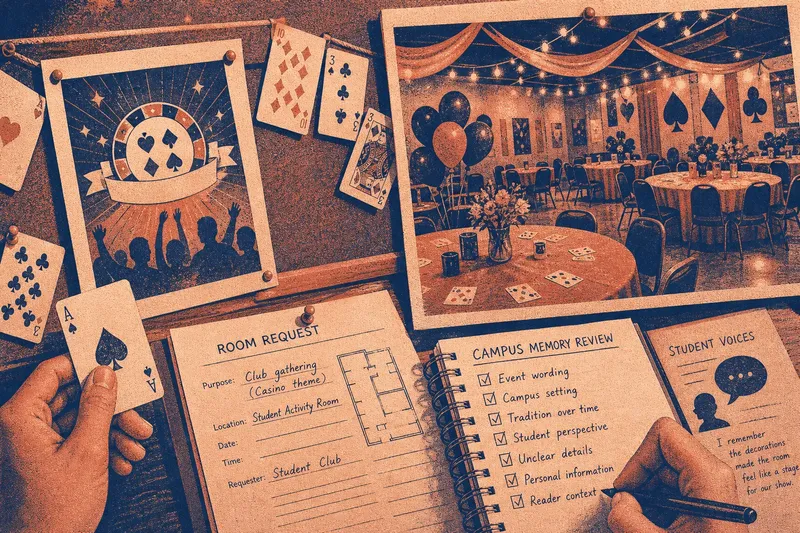
A student club pins paper playing cards to a campus noticeboard before an evening gathering. That modest decoration offers a useful starting point for understanding casino culture at Đại học Lạc Hồng: a borrowed visual language can become part of a campus tradition, even when the gathering is not a casino and its meaning is local.
How does casino culture become a campus tradition?
Tradition is not simply an event repeated on a calendar. It also grows through the small choices people remember and pass along: a familiar theme, a club’s way of welcoming newcomers, or a story about how an event came together. Casino imagery might be reused because it makes a gathering feel playful, theatrical, or distinctive. Those meanings belong to the people and setting involved; they should not be assumed from the cards alone.
At a university, a theme can shift as students change. One group may treat playing cards as decoration, while another uses them in a performance or as a conversation starter. Preserving that variation keeps campus memory from turning a living tradition into a single official explanation.
What does a casino theme mean on campus?
Casino culture includes many things beyond a themed student gathering: entertainment, hospitality, work, regulation, and public ideas about chance and risk. A campus event may borrow a visual motif without representing those wider histories or the experiences of people who work in casinos.
That distinction gives an exhibit or class discussion a sharper focus. Ask what the imagery did in its campus setting. Did it help establish a festive mood, frame a performance, or give students a shared theme? Describe what the available material supports, and leave broader claims about casino life to sources that address them directly.
How can a university preserve the tradition without fixing its meaning?
Preservation can hold onto both the object and the context around it. Alongside a flyer or photograph, a university might retain the event’s own wording, a student publication, or a voluntary recollection from someone involved. These materials can show how a tradition was presented and remembered without treating one person’s account as everyone’s view.
Imagine a fictional club with a card-themed poster, a room request, and a photograph of decorated tables. A curator records the poster’s wording, notes that the request sought campus space, and describes only the visible decorations in the photo. The resulting account can say the club planned a themed gathering in that room; because the file contains no attendance record or participant accounts, it cannot say who attended or what the theme meant to them. That boundary gives readers a clear, useful story without filling gaps with guesses.
Think of a tradition like a recipe card passed between cooks: the written instructions matter, but so do the notes added by each person who uses it. A campus display can preserve those changes rather than presenting one version as the final one.
What questions help interpret casino culture at Đại học Lạc Hồng?
Why might students choose casino imagery?
It could signal a playful theme, suit a performance, or help a gathering stand out. Compare the event’s own wording with the images before assigning a meaning to the organizers.
Can a photograph explain a campus tradition?
A photograph can show visible details such as decorations or room layout, but it cannot tell readers what participants thought. Pair it with a caption or student account when available, and keep the image’s limits clear.
How can a former student’s recollection be presented?
Identify the speaker’s connection to the event and present the account as that person’s memory. For interviews, follow the university’s consent and privacy practices, and avoid implying that one recollection represents every participant.
How can a display invite more than one reading?
Use plain-language captions and explain unfamiliar references without deciding what every reader should think. If student accounts differ, show the difference respectfully and make clear what the materials do and do not establish.
What should a campus-memory review check?
Before sharing material in a class, display, or online story, review the tradition as well as the individual items. Each check below links an observable detail to a practical decision.
- Event wording: Check whether the poster names the gathering. If it does, use the printed name; if it does not, describe the visible theme without inventing an event title.
- Campus setting: Check whether a room request or another record connects the material to Đại học Lạc Hồng. If it does, identify that documented setting; if it does not, describe the setting as unconfirmed or seek another record.
- Tradition over time: Check whether materials from different occasions show a repeated theme or practice. If they do, describe the documented recurrence; if they do not, present the item as one occasion rather than an established tradition.
- Student perspective: Check whether a publication or recollection identifies a participant’s interpretation. If it does, attribute that view; if it does not, avoid claiming that students shared a single meaning.
- Unclear details: Check whether the date, creator, or activity is missing from the material. If a detail is recorded, include it; if it is absent, mark it as unknown or leave it out.
- Personal information: Check whether a draft reveals identifiable personal details. If it does, consult the university’s relevant staff and access guidance before sharing; if it does not, continue with the usual review.
- Reader context: Check whether a caption explains unfamiliar symbols or terms. If it does, keep the explanation concise; if it does not, add plain-language context or an alternative description.
The audience shapes the presentation. In a classroom, students might compare how different groups used the same motif; a public display may need more explanation of the occasion and its place on campus. In either setting, preserving the tradition means showing how people made and remembered it—not making a decorative detail carry more history than it can bear.
Casino culture at Đại học Lạc Hồng becomes clearer when campus memory holds onto the changing meanings students give a theme. A careful caption can name what is visible, identify whose perspective is represented, and leave the next reader a useful question: how might another group have made the tradition its own?