Reading a Casino Token Through Its Changing Uses
See how a casino token’s changing uses connect design, collecting, and campus teaching, with a clear way to separate visible details from possible meanings.
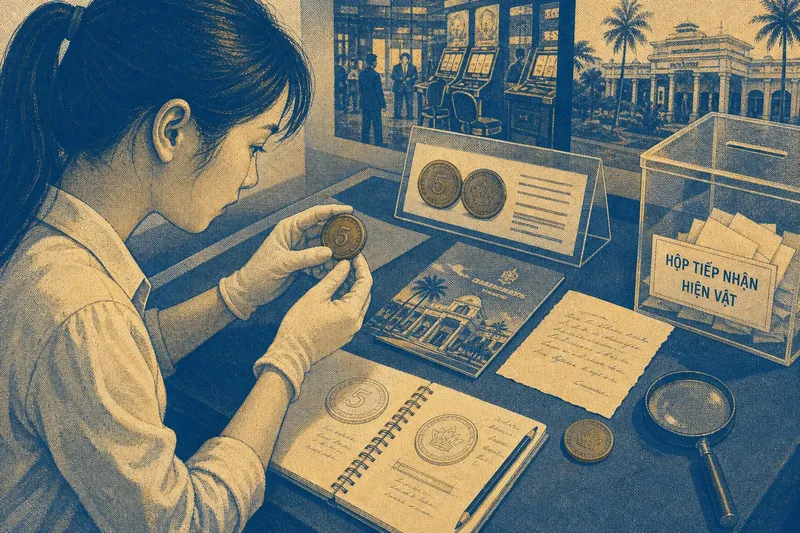
A brass-colored casino token slips from a coat pocket onto a desk at Đại học Lạc Hồng, beside a student’s notebook. A casino token’s changing uses can turn that small moment into a lesson about design, collecting, and the ways objects acquire new roles.
Imagine a hypothetical situation: student volunteer Linh receives a token, an undated venue brochure, and an unsigned note in a donation box. She plans a display that follows the token from a possible casino setting into a university collection. Rather than treating it as a stand-in for every casino visitor or worker, she uses it to ask how an object’s meaning shifts as it moves between settings.
What details make the token worth a closer look?
Linh starts with what visitors can see: a circular metal body, a numeral on one face, a partly obscured emblem on the other, and scratches along the rim. No venue name or date is visible. Those features make the token legible as a designed object, but they do not identify its maker or original purpose.
A numeral might have marked value, a table, or an internal category. An emblem could refer to a venue, a supplier, or a design used by several businesses. The token is like a key: its shape may be distinctive, but the shape alone does not tell you which door it fits.
This close looking gives a class something concrete to do. Students can sketch the faces, describe the rim, and separate deliberate design from changes caused by wear. Linh records those observations before suggesting meanings, so visitors can see where description ends and interpretation begins.
How does a token change as it moves?
A token may have circulated in a venue, been kept after a visit, passed between owners, entered a private collection, and later been donated. In each setting, its role can change: a piece of a venue’s routine may become a keepsake, a collectible, and then an object used for teaching.
For Linh, the brochure and unsigned note are leads, not a ready-made story. They arrived in the same donation box as the token, but that does not establish that they were kept together before the donation. She can display them nearby while explaining that their earlier relationship remains uncertain.
That decision brings the collection itself into view. The token can help students discuss the material culture of casino life: the objects used in routines, associated with venues, or kept as souvenirs. One object cannot represent every venue or experience, but it can open a focused conversation about how collections select and interpret evidence.
How can a class work with the object?
Students can sketch the token’s markings, compare them with images in a venue catalog, or discuss what changes when an object leaves its original setting. The exercise can connect visual analysis with questions about commerce, memory, and collecting without pretending to settle the token’s original function.
Say Linh’s hypothetical adviser locates a venue catalog with an emblem that matches the token. The catalog shows several token types and says nothing about the numeral. Linh revises the display to describe a possible venue connection, but does not assign a purpose to the numeral. The resulting account is more specific about the emblem and still open about the marking the catalog does not explain.
That is a useful classroom moment: new material can clarify one part of an interpretation without answering every question. If another document later explains the numeral, the university can show what changed and why, rather than presenting the first label as a finished verdict.
What questions help visitors interpret a casino token?
Can the numeral identify a value?
Not on its own. A venue record or another reliable account would need to connect the marking to a particular system before the label calls it a value rather than a code or identifier.
Does wear show that someone used it at a gaming table?
Wear shows that the surface changed through contact or storage, but it does not identify the setting or action. Linh can describe the scratches without inventing a scene around a particular player or game.
Can the brochure identify the token’s venue?
It may offer a lead if its emblem or details match the token, but the shared donation box alone does not link their earlier histories. Linh can distinguish a documented match from a possibility visitors might investigate.
Why explain what the collection cannot establish?
That distinction helps visitors see how interpretation works. Linh can point to a visible feature, explain the display’s reading of it, and name the kind of document that could support a stronger claim.
How should the display label describe the token?
Linh drafts a label that gives the object a clear place in the collection without claiming more about its original role than the available material supports:
Metal token with a numeral and emblem, received in a donation of materials associated with casino life. Its original venue and function are not established. A nearby brochure offers a possible lead, but its connection to this token is uncertain. How does an object change when it leaves the setting for which it was made and enters a university collection?
The question shifts attention from identification alone to the object’s campus life. At Đại học Lạc Hồng, the token can prompt discussion of how casino objects move from use to memory and then into public interpretation. If new documentation changes the account, the label can be revised to show visitors how the interpretation developed.
How can visitors distinguish observation from interpretation?
A concise prompt beside the label can make the difference visible. “The token has a numeral” describes what a visitor can see; “the numeral marks its value” proposes a meaning. For Linh’s display, each observation leads to a practical decision about what the label can responsibly say:
- Observation: the token has a numeral. If a venue record explains the marking, then describe that documented role; otherwise, leave its function open and compare it with other token designs.
- Observation: an emblem is partly visible. If a reliable comparison identifies it, then name the supported connection; otherwise, describe its visible shape without assigning it to a venue.
- Observation: the rim has scratches. If a conservation record explains their cause, then include that account; otherwise, describe the wear without attributing it to play or to a particular person.
- Observation: the token arrived with a brochure. If collection records connect them, then explain that documented relationship; otherwise, present the brochure as a separate research lead.
- Observation: a donor recalls keeping the token as a souvenir. If the donor agrees to share that memory, then attribute it as personal recollection; otherwise, keep the label to the documented donation history.
- Observation: a catalog matches the emblem but not the numeral. If the catalog supports a venue connection, then state that limited link; otherwise, leave the venue unidentified and use the catalog only for comparison.
These choices let one object support different lessons. A design discussion can focus on the emblem; a lesson about collecting can follow the move from venue to donation. Students can explore both without asking the token to represent the whole history of casino work, leisure, or personal memory.
For a campus display, the most useful account of a casino token’s changing uses makes its present role as clear as its uncertain past. The token is now part of a university collection—and a prompt for students to consider how objects carry, lose, and acquire meaning.